
Building Telco Journey Orchestration Around What Customers Actually Want
Telcos already use network signals to trigger customer journeys: top-ups, balance changes, plan activations, roaming events, usage thresholds, and more. These signals are valuable. They show what a customer is doing on the network at a specific point in time.
But they do not show the full picture. A customer’s network activity tells you what happened inside the provider’s environment. It does not always show what is happening on the user device, where intent often appears first.
What The Network Cannot See
Network signals can tell you when a customer tops up, activates a plan, crosses a balance threshold, or uses a certain amount of data. They cannot always tell you what else is happening on the device. Take dual-SIM usage. If a customer is using a second SIM from another operator, that activity is invisible if you rely only on your own network events. The network events tied to the other SIM belong to the other operator.
But the behavior on both SIMs is visible on the device hosting them.
Most dual-SIM users are not necessarily looking to replace their primary provider. Often, they are using a second SIM because it gives them something their current provider does not offer as well, such as better coverage, cheaper data, or more flexible services. That is actionable intelligence.
A provider that can identify this behavior has a better chance of responding with the right offer, at the right moment, before that secondary usage becomes a bigger commercial risk. And dual-SIM usage is only one example. Device-level intelligence surfaces a range of other signals providers can act on in the same way.
The Combined Picture
Device signals do not replace network signals. They make them more useful. Network signals tell you what a customer bought, when they topped up, how much data they used, or which plan they activated. Device signals on the other hand add context around how the customer is using their device in real time, what their behavior may suggest, and when they are most receptive to engagement. Together, they give CX and marketing teams a more complete view of the customer than either signal type can provide on its own.
That matters because journey orchestration is not just about knowing that an event happened. It is about knowing what to do next, when to act, and whether the customer is likely to respond.
Why Telco-Specific Engagement Matters
Customer engagement and journey orchestration are part of the same picture. The platform that runs a particular journey and its underlying workflows is also responsible for driving engagement. Many customer engagement platforms were built for broader industries and later adapted to telco. They can support generic customer journeys, but they are not always designed around the specific telco use cases, data sources, and decisioning needs that service providers face. And crucially, they can’t capture on-device signals.
Telcos operate in a more complex environment. They need to connect network events, billing data, eligibility rules, plan logic, device intelligence, and real-time customer behavior. They need to support journeys across prepaid, postpaid, roaming, win-back, upsell, retention, and service-led use cases. A telco-native engagement platform accounts for that complexity from the start. It combines network events and billing information with on-device intelligence, so providers can build engagement flows around the way customers actually use their services.
A Practical Example: Prepaid Plan Upgrade
Consider an automated workflow for prepaid plan upgrades driven by balance changes.
A customer’s balance moves above a threshold, for example $30. A signal fires in real time. The workflow checks whether the customer is eligible for a specific upgrade offer, such as a plan that includes 5GB of bonus data. If they are eligible, the offer can be presented.
If the customer’s balance is below the threshold, the workflow prompts them to top up and waits. Once their balance moves back above $30, the upgrade offer becomes available again automatically. That flow can be managed using network and billing data.
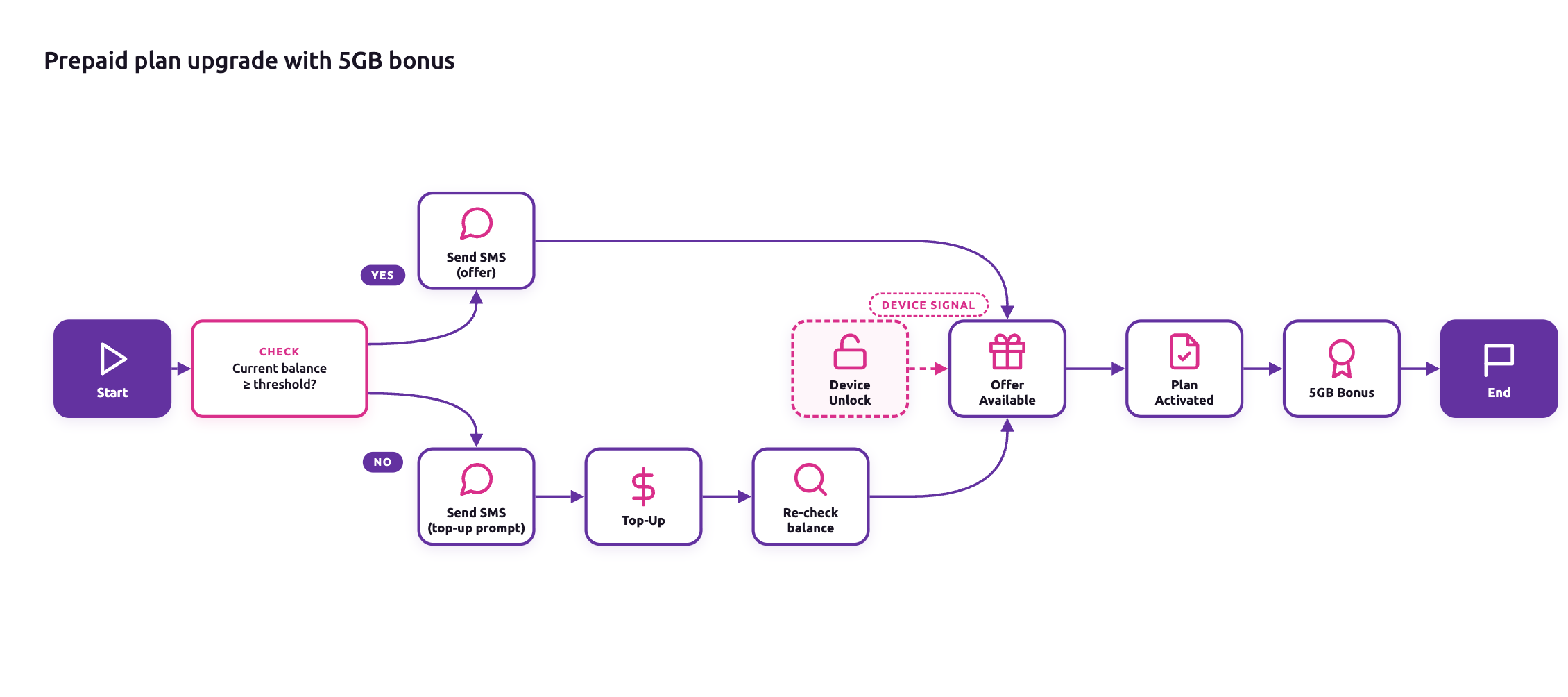
But there is still an important question: when should the provider present the offer? Should it appear immediately when the balance threshold is met? Should it wait until the customer is actively using their device? Should it appear when the customer is more likely to engage?
This is where a telco specific customer engagement platform that incorporates device signals improves the journey. By adding device context to the same flow, the provider can present the offer at a moment when the customer is genuinely engaged, rather than simply reacting to the network event as soon as it happens.
The journey becomes more precise. The timing improves. The offer feels more relevant. And take-up rates are more likely to move in the right direction.
From Campaign-Led To Experience-Led
The next step in telco journey orchestration is not simply adding more campaigns, channels, or touchpoints. It is building a more complete picture of the customer by combining network intelligence with real-time device context. That gives providers a better way to understand what customers are doing, what they may need next, and when they are most likely to respond.
For telcos, this changes the role of journey orchestration. It moves the focus from triggering campaigns around isolated events to creating automated, personalized experiences around what customers are actually doing. In a market where customer attention is harder to earn and easier to lose, that difference matters.